

Co-Authors Chris Roy – Orange County Farm Supply / Patricia Fintland / Frank Wagoner
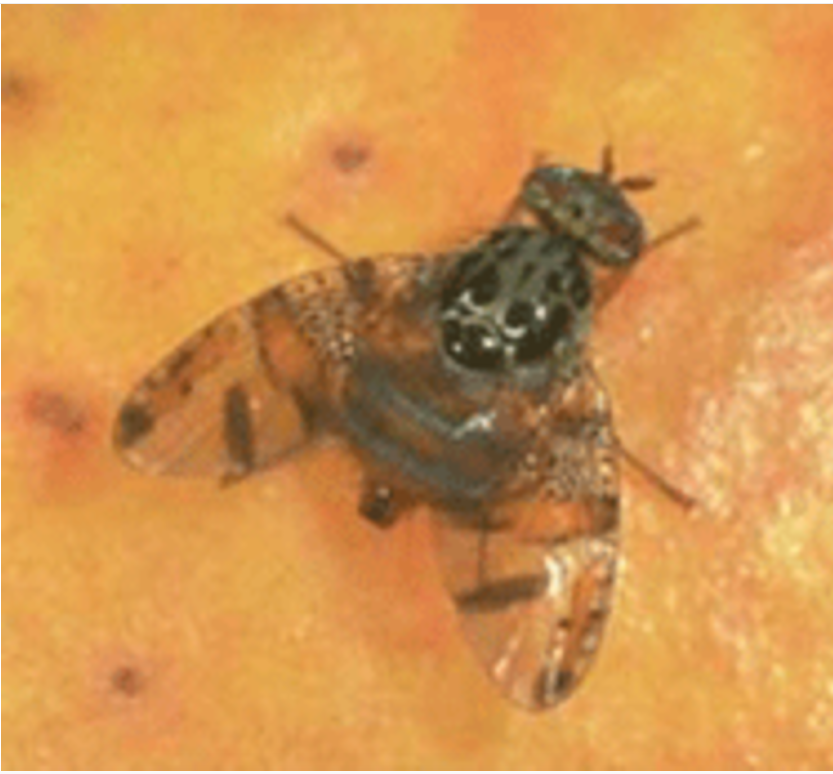
Imagine growing a fruit tree and eating the fruit at peak of freshness. Now imagine something that can cause all the fruit on a fruit tree to become inedible! And simple understanding can help identify and address the issue early before it gets out of control. Fruit flies are found all over the world. In most pest species, the adult females lay eggs in fruit and the larvae feed in this fruit, which makes them economic pests when these fruits are cultivated for human consumption. Fruit flies are especially serious pests in tropical and subtropical regions. Because all the crops grown in California originated from other parts of the world, this created an ideal situation for the pests to establish themselves. The mild climates of Southern California, as well as the mild coastal climates of Northern California benefit from ideal year-round weather for backyard growers to produce their favorite crops. This ideal weather (without serious freezes) also makes the region susceptible to infestation by invasive fruit flies from tropical and subtropical climates. There are over 100 species of fruit fly native to California, but there are a few that have been accidentally introduced and are now established, like the olive fruit fly, while the peacock fly that was intentionally introduced as thistle control agents. Among the many species of invasive fruit flies from around the world that threaten California’s agriculture and environment, a few are detected regularly and must be eradicated. The most common are the Mediterranean fruit fly, Oriental fruit fly, and Mexican fruit fly. These invasive fruit flies are not native to California and have the potential, if not eradicated, to damage crops (especially tree fruit crops, such as citrus, avocado, and stone fruit), trigger increased pesticide use (both for minimizing pest damage to crops as well as for regulatory compliance), can cause environmental or health impacts resulting from this increased pesticide use, and risk loss of markets (other states and countries typically do not want to accept fruit that poses a risk of introducing an invasive fruit fly). The California Department of Food and Agriculture (CDFA), the United States Department of Agriculture (USDA), and California counties work together to detect invasive fruit flies and, if any infestation is detected, delimit and eradicate the infestation and implement quarantines to prevent spread of the infestation.
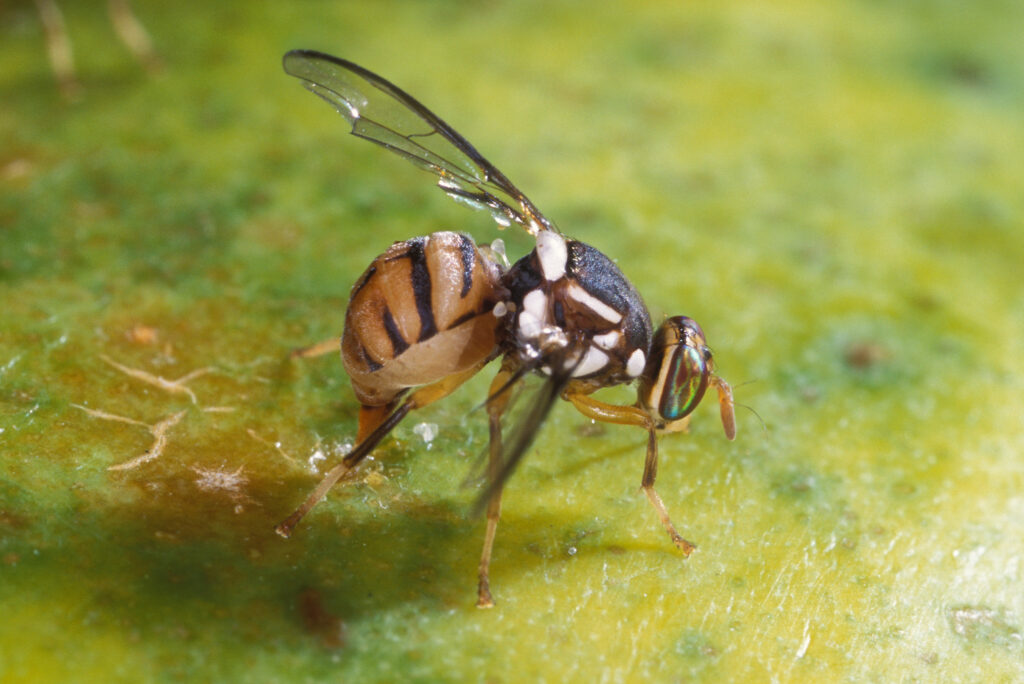
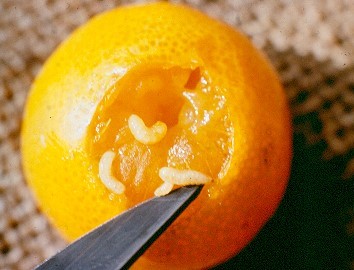
As mentioned, most invasive fruit flies lay their eggs inside the host fruits. When the eggs hatch, the larvae consume and destroy the inside of the fruits. The damage also allows decay causing organisms into the fruit, resulting in more damage than would be inflicted by feeding alone. The fully-grown larvae then drop down into the soil beneath and pupate. Finally, adult flies emerge, mate, and continue the cycle. Generally, fruit flies develop more rapidly at higher temperatures until some threshold is reached. In the summer, some invasive fruit flies could complete a generation (egg to adult) in approximately one month. The rapid development makes timely detection and (if an infestation is detected) eradication critical.
CDFA, in concert with most of the County Agricultural Commissioners, deploys and maintains over 63,000 detection traps statewide just for invasive fruit flies.1 Most of the invasive fruit fly eradications and quarantines involve a few “usual suspects,” including Mediterranean fruit fly, Oriental fruit fly, and Mexican fruit fly. However, there have recently been some quarantines for invasive fruit flies not typically detected in California. For example, the Queensland fruit fly was found in Los Angeles and Ventura counties, and Tau fly in Los Angeles County. Most invasive fruit fly infestations in California likely originate with smuggled infested fruit, either via passenger baggage or parcels shipped or transported into the state, including through ecommerce. As the types of fruit being sought in the state, and the potential sources of these fruits change, so do the types of flies that are introduced.
Several actions are taken once an infestation of invasive fruit flies is detected and delimited. The tools available to combat a given invasive fruit fly differ and are dependent on various factors, including the biology of the fly (e.g., attraction to certain chemicals or food-based lures) and history of eradication efforts with that fly. Eradication actions in California can include sterile release, where sterile male fruit flies are released to decrease reproduction in the population, male attraction technique (MAT), where a lure is combined with an insecticide in a sticky matrix and a few drops of this mixture is applied to various outdoor objects, like telephone poles (male flies feed on this and die), foliar or bait sprays, where a food bait is combined with insecticide and sprayed on host plants (flies feed on this and die), and fruit stripping (removal of host fruit). Intensive surveys for fruit fly larvae in fruits can also be done. Some, but not all, of these may be done for a given invasive fruit fly. For example, sterile release is done for Mediterranean fruit fly, and in fact is done in the Los Angeles area preventatively (not in response to a detection) because risk of Mediterranean fruit fly infestation is considered to be high in that area. Sterile release is not an option for the vast majority of invasive fruit flies because colonies do not exist and the rearing and release processes have not been studied and optimized for those species.
Quarantines involve regulating the movement of potential host material within and out of a particular area (the quarantine area). A quarantine lasts for three life cycles past the last fly detected as part of that quarantine project. As mentioned before, the length of a life cycle is dependent on temperature. The quarantine can only be declared over when the observed temperature data from the date of the last fly found is analyzed and found to support (based on a model) that three life cycles have occurred.
With pests, as with many things, preventing a problem is much more effective than responding to one that has developed. Ideally, Californians, visitors, and others would not smuggle fruit and invasive fruit flies would not be an issue in the state. That being said, CDFA, USDA, and county personnel work tirelessly to protect the state from invasive fruit fly infestations and eradicate them before they are unmanageable. There is a lot that Californians can do to help, including cooperation with state/county personnel when they request access to property to inspect for host material or to set traps. For backyard fruit growers, this is especially critical, as many of the fruits popular in California are hosts for invasive fruit flies and growers can find themselves at “ground zero” of an infestation.
At all times it is important to be careful where one accepts fruit from. Getting fruit from an affected area could spread an invasive fruit fly. No fruit should be accepted from an invasive fruit fly quarantine area. It should not be assumed that infested fruit will be obvious to a quick inspection. Certain varieties of fruit while thick skinned make it difficult for the larvae to enter EXCEPT when the stem is removed or broken off, creating a soft entrance.
Prevention Tips for Backyard Growers
- Unless otherwise instructed by CDFA or county personnel, fallen fruits and vegetables that have made contact with the soil should be picked up, and disposed of them in the waste bin, NOT compost or green waste bins.
- Spread coffee grounds under our fruit trees and vegetables. Coffee grounds release compounds which repel insects. Coffee grounds are very easy to obtain since there are many Starbucks, Dunkin Donuts, McDonald’s, etc. around and many establishments are happy to give them away for free.
- Make traps. Fill glass jars about halfway with apple cider vinegar and add a drop of Dawn dish soap. Cover with Saran wrap and secure with a rubber band. Then poke a few small holes in the top of the Saran wrap. The apple cider vinegar is irresistible to some fruit flies (namely Drosophilidae); vinegar flies like the SWD as it smells like fermenting, over-ripened fruit. The Dawn soap aids in drowning the flies. For Tephritidae fruit flies which are not attracted by vinegar, some current baits are Torula Yeast Bait, Vial-Lures, and specialized Protein Baits.
- Another option is to spray trees and vegetables. Use Spinosad, which is an organic OMRI listed larvicide. Many companies sell products available locally. Typically available in concentrate form or ready-to-spray bottles. Spray these throughout fruit development but limit to only six applications during a year. There is also a Spinosad product available for commercial use, called GF-120 NF Naturalyte.
It takes all of us to make a difference.
The CDFA offers options to report fruit fly concerns:
- Pest Hotline: 1-800-491-1899
- Report a Pest Web App
- Report a Pest Sighting Form
Additional information links:
- https://www.cdfa.ca.gov/plant/fruitfly/
- https://www.cdfa.ca.gov/plant/PE/InteriorExclusion/current_ff_erad.html
- https://youtu.be/g4mNqXuoOic
Which Fly Is It?
Check these CDFA links for further information about fruit fly identification, prevention and eradication:
| Pest Name | Information Links |
| Oriental Fruit Fly | Pest Profile Fact Sheet Brochure: Impact on You |
| Mediterranean Fruit Fly Destructive pest that attacks more than 250 kinds of fruits, nuts and vegetables. | Pest Profile Fact Sheet Brochure: Impact on You |
| Tau Fruit Fly | Pest Profile |
| Queensland Fruit Fly | Pest Profile |
| Notice of Treatment Areas Lists counties and maps with treatments underway per identified fruit fly. | CDFA Notice of Treatment Maps |
These are the sources and links for the added article content:
California Department of Food and Agriculture, https://www.cdfa.ca.gov/plant/PE/InteriorExclusion/current_ff_erad.html
CDFA support staff who contributed to our article
Jay Van Rein CDFA Acting Director Public Affairs
Kyle, Beucke CDFA Primary State Entomologist
Dr Martin Hauser CDFA Senior Environmental Scientist
Dr Jason Leathers CDFA